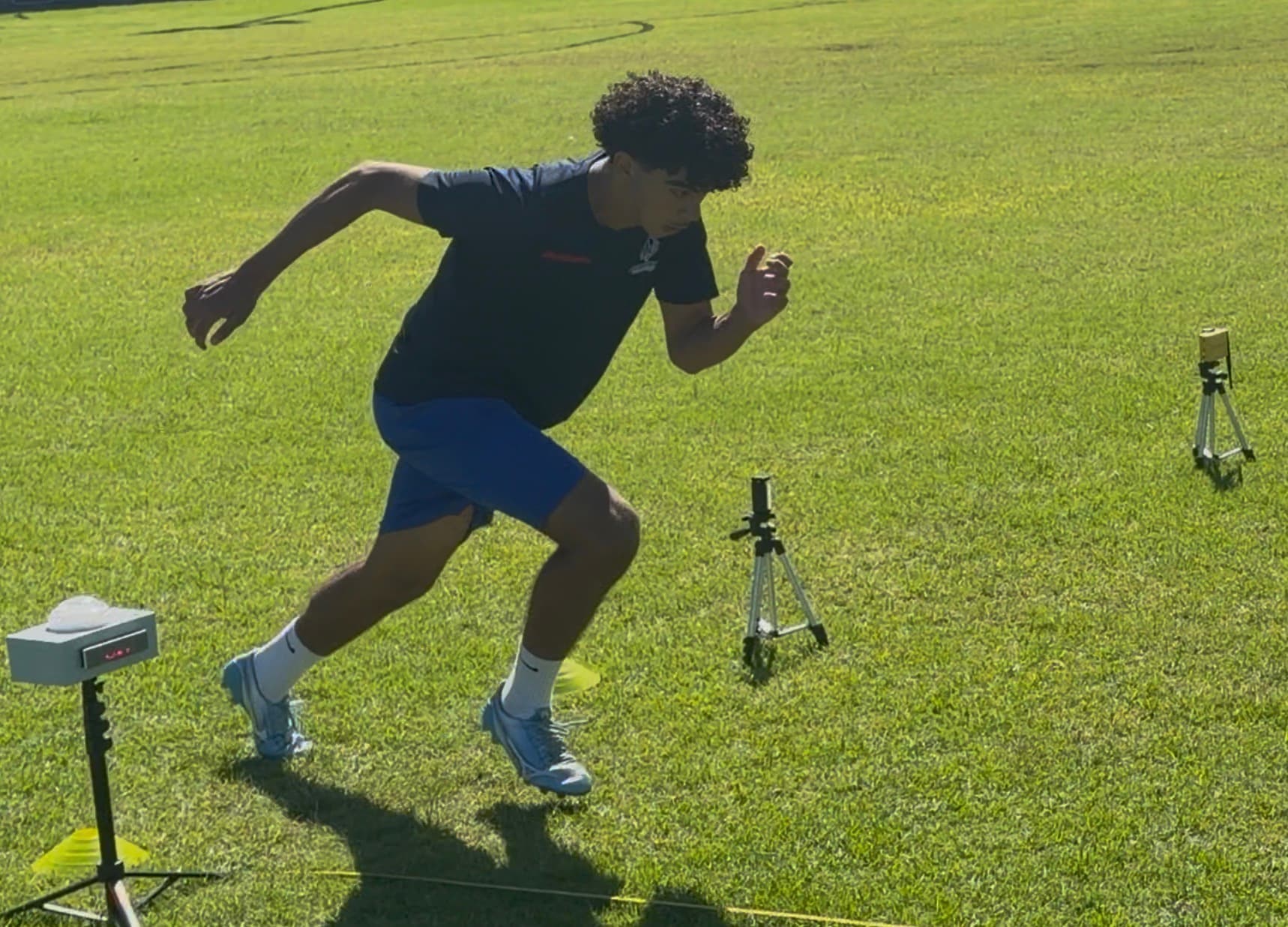
Flagship Program
Speed School
“He's just not built for speed.” “It's not in his DNA.” Really? Where's your data on that?
Speed isn't genetic. It's a skill. After 23 years and thousands of athletes, I haven't found an exception.
It's not a genetic
deficit. It's a
knowledge deficit.
Everyone wants to blame genetics. You don't have a billion genetic markers mapped out. You have an excuse.
We've taken athletes from 17 km/h to 38 km/h. Not hope. Not luck. By identifying limiting factors and solving them one by one.
Every athlete in our system was told they weren't fast enough at some point. We didn't change their genetics. We changed what we looked at.
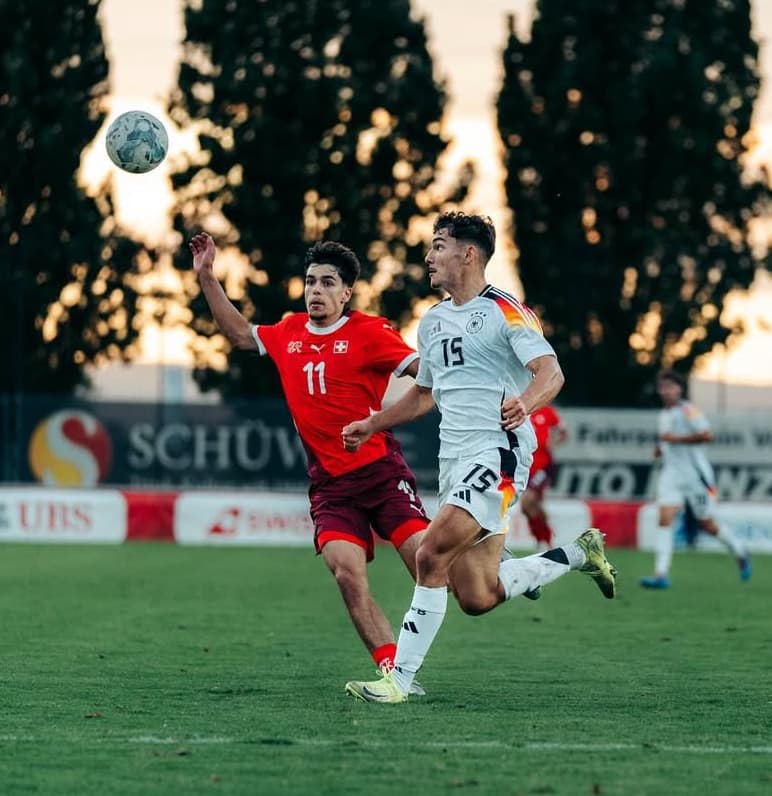
Pro Footballer · Still In The System
Sean Dulic, 3rd division to Bundesliga in 15 months
The Real Limiting Factors
Ground Contact Time
How long your foot sits on the ground. Less = faster. Most athletes waste energy here.
Reactive Strength
Absorb and redirect force instantly. This makes first steps explosive.
Force Production
How much force per step, at the right angle. More force = faster acceleration.
Nervous System Efficiency
How fast your brain fires signals. Trainable. Most coaches ignore it entirely.
17 → 38 km/h
Not genetics. System.
If no one around your athlete knows what to measure, what to fix, and how to build a system around it, that's the real reason they're not getting faster.
No assessment. No baseline. No limiting factor profile. Just guessing, and wondering why they plateau. That's how most athletes train. We built a system that closes that gap.
The Diagnosis
Why most athletes never get fast.
Speed is a skill, not a genetic gift. After 23 years and thousands of athletes, the ones who look “naturally fast” are just skilful in specific areas. Stiff tendons. Reactive nervous system. The right muscle in the right place. All trainable.
Most athletes are leaking 3, 4, even 5 km/h on every sprint, and no one has ever told them where. Here's what we find on day one.
Anthony, on speed as a skill, not a genetic gift.
The 25-millisecond tax no one's measured
Most athletes spend 110 milliseconds on the ground at top speed. Elite spend 85. Drop that 25ms, without changing anything else, and you've gained 3 to 4 km/h. Nobody ever told them. We measure it on day one.
Landing in front of centre of mass
Every step, the lead foot lands ahead of the hip. That's a braking force on every single contact. They're slowing themselves down and don't know it. The fix isn't more drills, it's the foot landing under the body.
180ms wasted before the first step
Most athletes lift the front leg to initiate movement instead of pushing with the back. 180 milliseconds of delay before they apply any force. They're maneuvering, not driving. Habit, not genetics, and it's fixable in weeks.
The nervous system has them locked
The nervous system only activates as many muscle fibres as it feels safe to. If you've been there before, it fires. If you haven't, it won't. Most athletes are locked at the speeds they've already proven, and need exposure to unlock the next ceiling.
The chain compounds
Tension in the face slows the arms. Tension in the arms slows the leg turnover, arms fire the legs first. The knee can't handle the force, so the ankle gives. Each link breaks the next. No one's been looking at the whole chain. We are.
Eyes alone don't catch it
Most coaches diagnose with their eyes at full speed. We film at 240fps. Slow it down and the deformation, the braking, the asymmetries become impossible to miss. You don't override what an athlete's body has solved, not without data.
Why It Stays Locked
The nervous system only fires what it's seen before.
The reason most athletes plateau isn't effort. It's a survival mechanism. The nervous system only activates as many muscle fibres as it feels safe to. If you've been at that speed before, it fires. If you haven't, it won't.
Exposure breaks the ceiling. We engineer the conditions where the nervous system perceives the next gear as safe, then it unlocks.
There's no genetic ceiling holding you back.
There's a knowledge gap. We close it.
Proof Over Promises
The system, on the clock.
Every number below was filmed, timed, and verified. This is what the same assessment, same prescription, same arc produces, across hundreds of athletes.
17-18 → 37 km/h
Hais
Below average to elite · Head Coach
17-19 → 35 km/h
George Francis
Started at 11 · stride, hip, contact rebuilt
23 → 32 km/h
Maksim
+27% avg speed · +56% bound power
30 → 35 km/h
Hadi
Plateaued & injured → 35 km/h in 8 weeks
The Prescription
Three tiers. Each one trained against your data.
Once the assessment names your limiting factors, the program slots into three tiers, ranked by which fix moves your numbers fastest.
Tier 1
Max Velocity & Sprint Mechanics
Frontside mechanics, knee drive, ground contact efficiency, triple extension at toe-off.
- Hip extension at toe-off
- Ground contact efficiency
- Frontside mechanics & knee drive
- Stride length development
Tier 2
Horizontal Power & Elastic Strength
Stretch-shortening cycle, posterior chain, elastic strength, the biggest leverage point for most athletes.
- Stretch-shortening cycle development
- Posterior chain force production
- Reactive plyometric capacity
- Horizontal power transfer
Tier 3
Reactive Speed & First Step
Reaction processing, first 3 steps, sport-specific speed expression under stimulus.
- Reaction processing under stimulus
- Low drive angle, aggressive arm pump
- Sport-specific speed expression
- Recovery & transition speed
The Bridge, Tier 2 → Tier 1
More force into the ground.
That's your first 15 metres.
The single connection most coaches miss: strength in the gym isn't the goal, it's the input for acceleration. If you haven't hit a personal best in the squat in a while, you're leaving force on the table, and the place you feel it first is the 0 to 15m sprint.
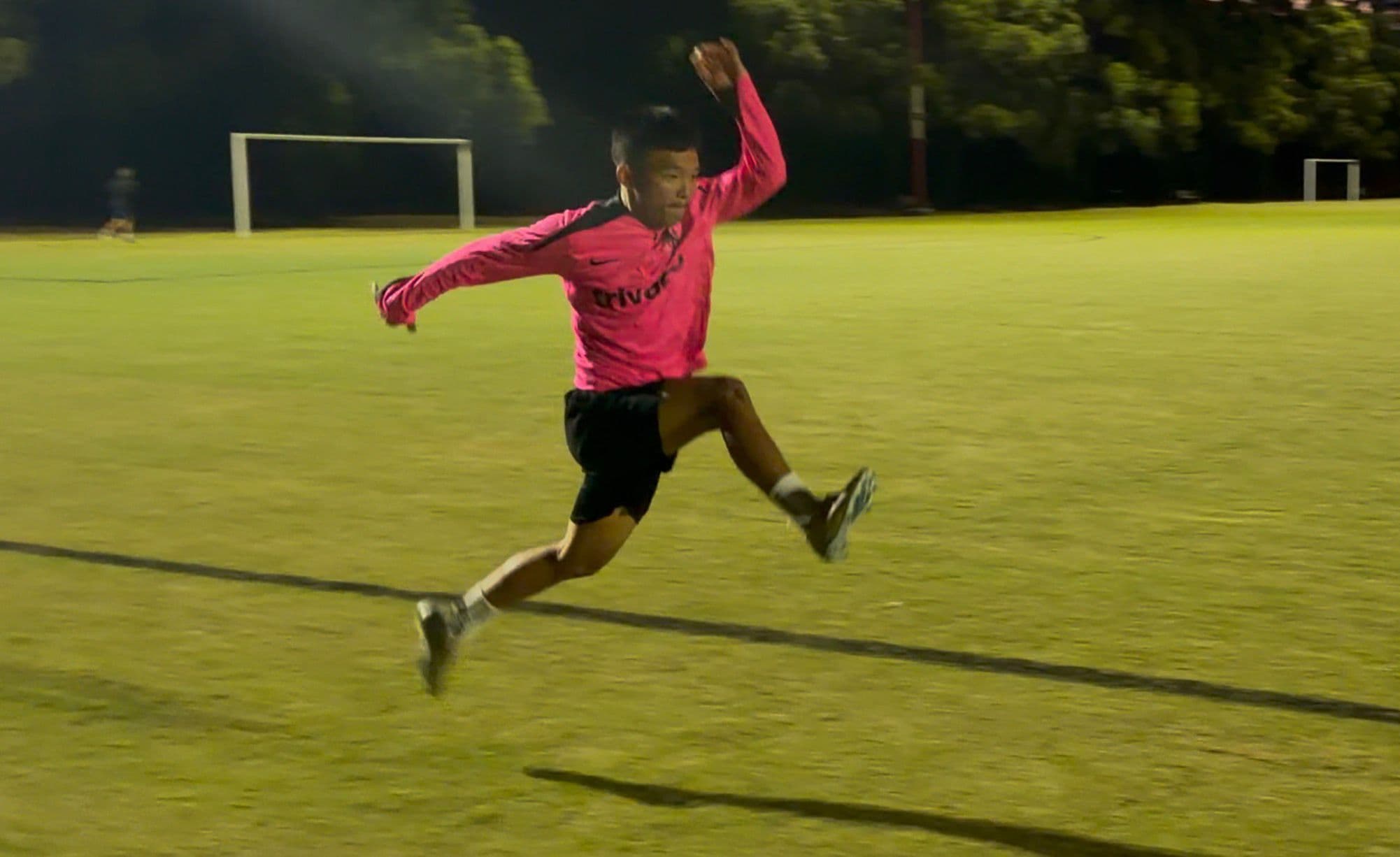
A single-leg horizontal bound, force into the ground made visible. Distance per bound is one of the truest readouts of elastic power and a direct predictor of acceleration.
01 · Input
Heavier squat at the right speed → more force the leg can apply per ground contact.
02 · Transfer
More force in the same ground contact time → bigger horizontal projection per stride.
03 · Output
Faster 0 to 15m. Quicker first 5 steps. The phase where games are won.
Most athletes stop hitting PRs and assume they've plateaued at the gym. They haven't, the gym is the floor under their sprint, not a separate game. We measure both, and the bottleneck always points to the input that's no longer growing.
The 3-Year Arc
Foundation. Integration. Dominance.
A single 6-week block moves numbers. A 3-year arc redefines what the athlete is capable of. This is the development vision we build every program against.
Year 1
Foundation
Max velocity mechanics rebuilt. Horizontal power baseline. Strength under the hood. Every metric measured against elite, every gap named.
Year 2
Integration
Advanced plyometrics. Reactive agility. Sport-specific expression. The mechanics start firing under stimulus and fatigue.
Year 3
Dominance
Senior-level top speed. Elite elastic power. The athlete now sets the bar, they don't chase it.
Most athletes plateau because no one zoomed out far enough. We build for the 3-year arc, even when the goal is the next 6 weeks.
Where we train.
Georges Hall
Crest Soccer Fields, Georges Hall NSW 2198
Riverine Park
Riverine Park, Arncliffe NSW 2205
Bressington Park
Bressington Park, Homebush NSW 2140
Online
Worldwide
Got Questions?
The common ones, answered.
Everything we get asked before the assessment. If your question isn't here, bring it to the application.
What does the assessment actually look like?+
What sports does Speed School work for?+
How long until I see real results?+
What's the minimum commitment?+
Can I keep doing my club training alongside this?+
What if I'm injured or get injured mid-program?+
Are coaches WWCC and first-aid certified?+
What if I miss a session?+
How is this different from other speed coaches in Sydney?+
What does it cost?+
Our Guarantee
First-session guarantee. Or your money back.
If your first assessment session doesn't deliver three things, specific numbers, your #1 limiter named explicitly, and a clear training prescription, we'll refund it in full. No quibbles, no “keep training and see.”
Apply For Speed School
Find out what's actually holding you back.
Apply for a biomechanical assessment. Laser timing. 240fps video. 20+ indicators. Limiting factors named, bottlenecks tackled.
- Reviewed within 24 hours
- Anthony reviews every application personally
- Honest fit-check, no chasing, no false promises
, Anthony, Founder, Ambition Sports Performance
Speed School Application
Strict intake. Apply to qualify.
A 90-second application qualifies you before we book anything.
Sydney athletes only · $250 assessment · serious athletes only.
Reviewed within 24 hours · Limited spots